
di Elvira Visciòla
For over thirty years, Göbekli Tepe has revealed a presence as discreet as it is enigmatic: that of the dead. Not through intact tombs or necropolises, but through hundreds of human bone fragments found in the fills of the site's monumental structures. Fragments belonging to men and women of different ages, scattered among sediments and fill materials, and in many cases impossible to trace back to a specific individual or burial.
Now, for the first time, two relatively intact burials offer a comparison for understanding the history of those remains. A study by Julia Gresky and Lee Clare, published September 22, 2026, in the journal PLOS ONE (see “First burials give insights into mortuary rites at Göbeklitepe, Early Neolithic Türkiye | PLOS One”), in fact, proposes a new interpretation of the presence of the human bones scattered at Göbekli Tepe. According to the authors, a significant portion of these remains could come from originally intact burials, subsequently affected by the processes of erosion and accumulation of sediment on the hillside.
The new interpretation, however, does not completely resolve the issue. Some skulls, in fact, display intentional modifications that continue to suggest the existence of different funerary practices and, perhaps, specific forms of treatment of human remains.
A monumental site in the heart of the Anatolian Neolithic
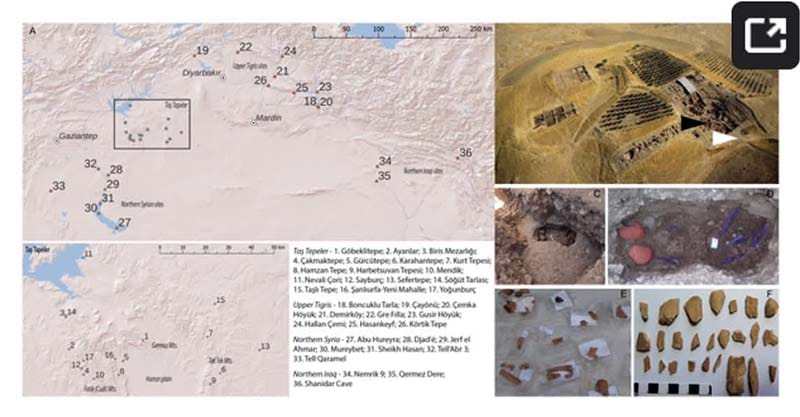
Göbekli Tepe is located in southeastern Turkey, in the Sanlıurfa region, and is one of the most important Neolithic archaeological complexes in the Near East. The site is characterized by large monumental structures, often circular or oval, within which the famous T-shaped pillars were erected, some of which are decorated with representations of wild animals, human figures, and incised or carved motifs.
The first monumental structures date to the late 10th and early 9th millennium BCE, within the context of the Pre-Pottery Neolithic. Research in recent decades has progressively altered the initial image of Göbekli Tepe as an exclusive ceremonial center separate from settlements. More recent investigations have documented a greater complexity in the site's occupation and the coexistence of activities that appear to belong to both ritual and everyday spheres. It is precisely within this context that the problem of human remains arises.
Since the first excavation campaigns, begun in 1995, human bone fragments have been recovered primarily in the fills of the so-called special buildings, the site's large monumental structures. The anthropological material includes individuals of both sexes and of various age groups, but their dispersion made it extremely difficult to determine whether they were the remains of destroyed burials, intentional depositions, or a specific funerary practice.
The issue takes on particular significance in a region where the treatment of the deceased during the Early Neolithic appears to be extremely diverse. Burials beneath the floors of dwellings, multiple burials, and practices specifically involving the skull are documented at several sites in eastern Anatolia. Göbekli Tepe, however, seemed to stand out precisely for the absence, until recently, of intact burials.
The first two burials
The breakthrough came with the identification of two burials attributable to the Pre-Pottery Neolithic B, dated at the site between 8700 and 8000 BCE. These are the first complete burials documented at Göbekli Tepe and therefore constitute an important point of comparison for interpreting the complex of human remains discovered at the site. The first burial, discovered in 2017 during work related to the construction of a drainage canal, was located beneath the plastered floor of a rectangular building. The pit contained the remains of at least three individuals: an adult woman over 35 years old, a man between the ages of 20 and 30, and a young woman aged approximately 11–14. The arrangement of the remains suggests that the skulls were concentrated in one area of the pit, while some of the postcranial bones were accumulated in other areas.
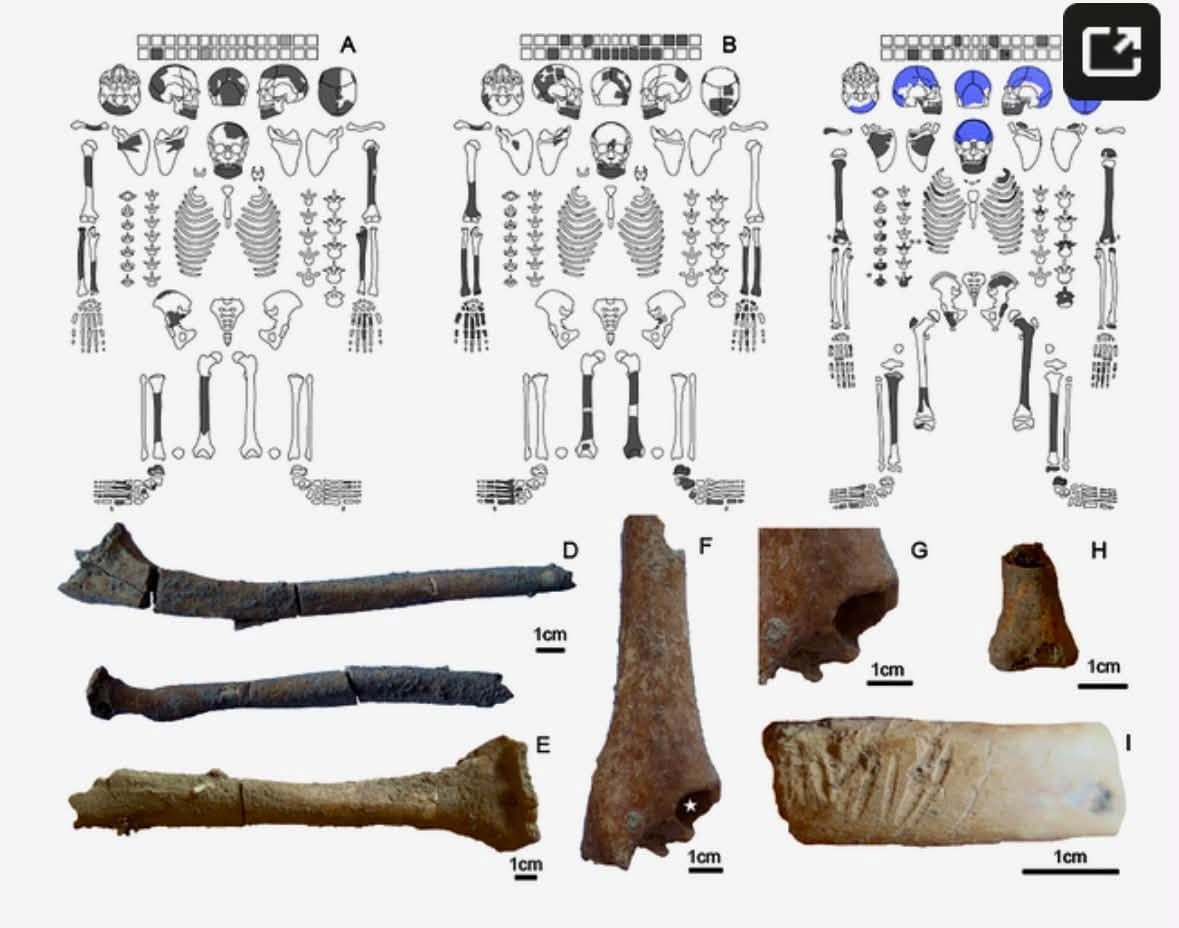
The anthropological analysis also leaves open the possibility that a fourth individual was represented in the deposition, based on some remains that cannot be perfectly associated with the three identified subjects.
The configuration and dimensions of the pit suggest that the bodies were not necessarily deposited at the same time, but that they occurred at different times and the remains were then moved to allow for new burials.
Of particular note is the lack of evidence of combustion, ochre treatment, or specific traces of butchery on the remains. The presence of small hand and foot bones also indicates that the individuals were originally buried as relatively complete bodies.
The second burial, identified in 2012 and fully excavated only in 2022, is located in a small room immediately west of Enclosure A. It contained the remains of a young woman of approximately 20-30 years old, laid on her left side, with her legs bent and her face oriented toward the east. The body was placed on a layer of stones.
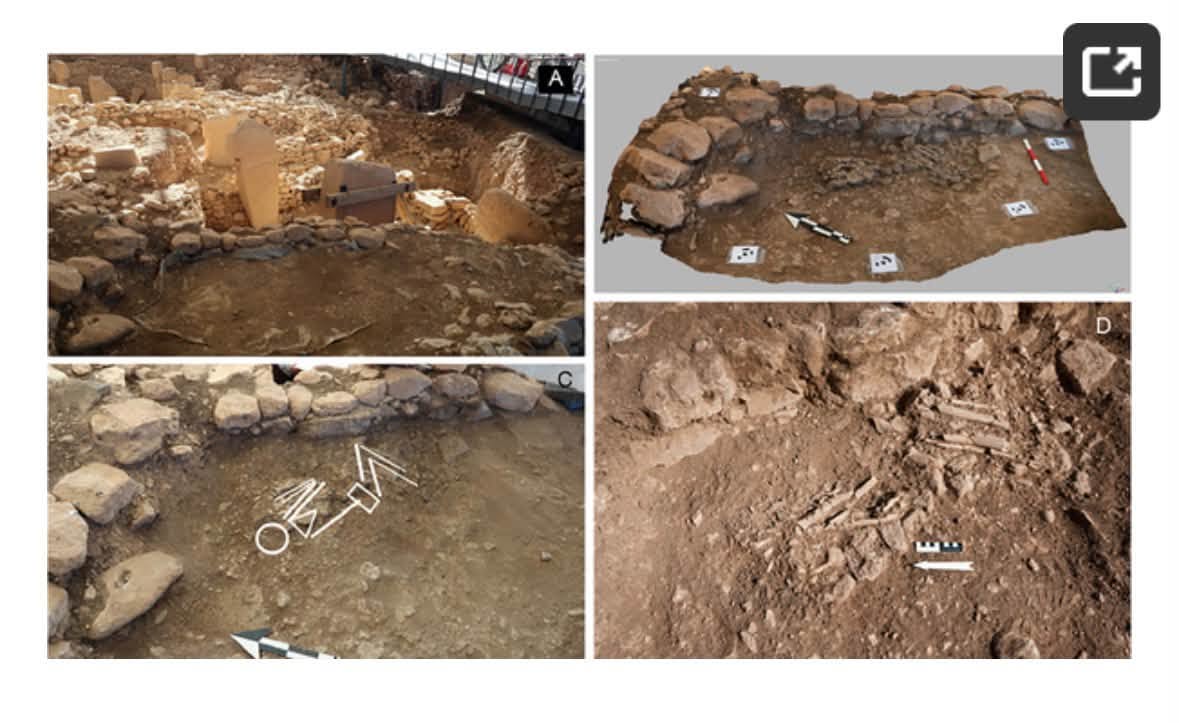
Even in this case, some cranial fragments present characteristics that do not allow a certain attribution to the buried woman, leaving open the possibility that at least some of the human material present in the area has a different depositional history.
When taphonomy becomes the key to interpretation
It is precisely the taphonomic analysis of the two burials that provides the main novelty of the study.
The remains from the two depositions show fragmentation and alteration processes very similar to those observed in the human fragments scattered in the fills of monumental structures. The bones show fractures, traces of rodent gnawing, and, above all, extensive calcareous encrustations.
In the first burial, encrustations affected approximately 61% of the fragments analyzed. The formation of these concretions may contribute to bone fragmentation and subsequent disarticulation.
A particularly significant finding comes from the second burial. Although the young woman's skeleton remained essentially in its original position, her bones were severely fragmented: the ends of several long bones were lost, and some exhibited multiple fractures.
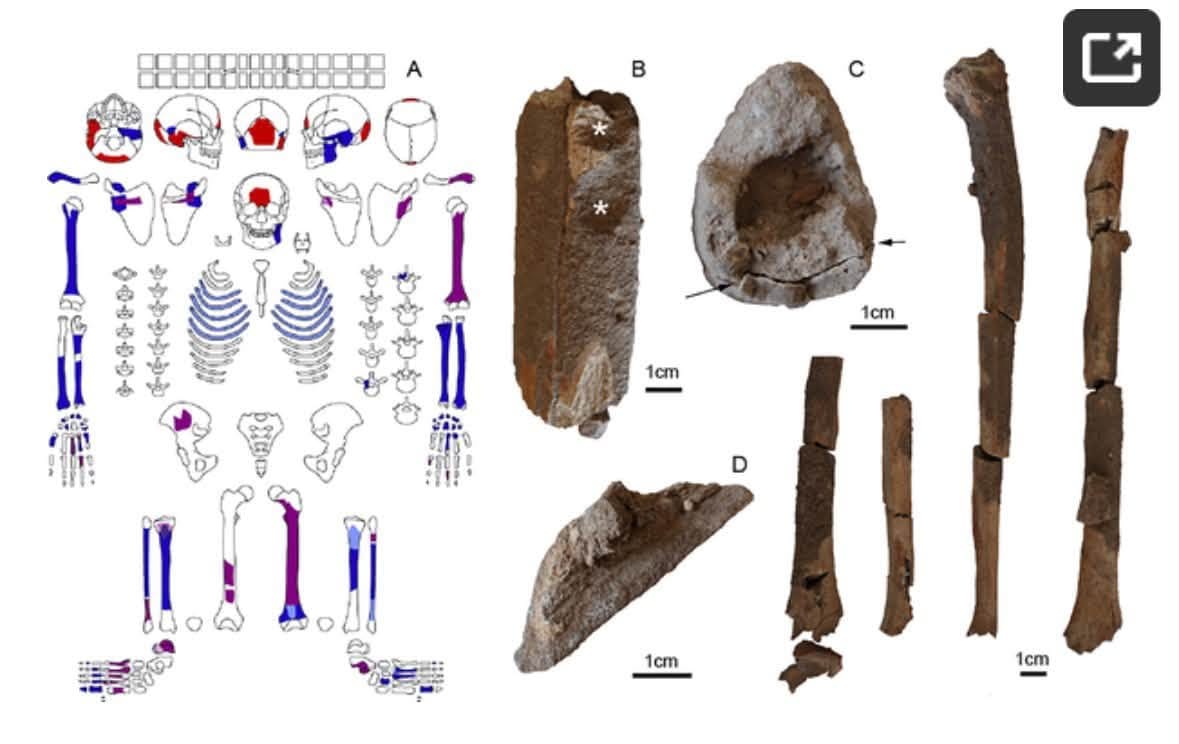
This observation allows us to formulate a new hypothesis on the origin of at least some of the human fragments scattered at Göbekli Tepe.
A moving hill
According to Gresky and Clare, some of the burials originally located in the higher areas of the settlement may have been progressively affected by erosion and accumulation processes along the hillside.
Deposits from the higher areas would have transported sediments, building materials, and human remains to the lower areas. The monumental structures of Göbekli Tepe are in fact located lower than other parts of the site and may have gradually received materials from the areas above.
From this perspective, the dispersion of bone fragments would not necessarily be the result of an intentional ritual practice. Some of the material may have been transported and mixed by natural and anthropogenic processes over the site's long history.
The distribution of the fragments also seems compatible with this interpretation.
But the problem of the skulls remains
Indeed, at Göbekli Tepe there is a body of evidence that continues to suggest an intentional treatment of some cranial remains.
Already in 2017, Julia Gresky, Juliane Haelm, and Lee Clare analyzed fragments of three skulls characterized by intentional modifications. Some showed deep incisions along the midline, while one fragment also featured a hole. This evidence was interpreted as possible evidence of a previously unknown form of ritual skull treatment in the Early Neolithic of Anatolia.
The 2026 research broadens the picture, but remains cautious. The cranial modifications cannot be simply explained by the taphonomic processes identified for the other fragments.
The key point is therefore to distinguish two phenomena that could have coexisted: on the one hand, the presence of human remains dispersed following the transformation of the deposits and erosion of the site; on the other, intentional practices of treatment of certain human remains.
It is precisely this distinction that makes Göbekli Tepe particularly interesting.
A possible skull cult?
The treatment of skulls would not be unique in the Anatolian and Levantine Neolithic landscape. At Çayönü, for example, the so-called Skull Building is known, while practices involving the manipulation and preservation of skulls are documented at other sites in the region.
At Göbekli Tepe, however, the modifications observed on some fragments present peculiar characteristics. Previous research had identified seven modified cranial fragments belonging to three individuals, with incisions and other intentional alterations.
The site's iconography has also fueled debate. Some depictions show headless human figures, while other depictions and decorative motifs have been linked to the treatment of death and the deceased.
These elements, however, do not constitute proof of the existence of a true "skull cult." The term risks suggesting a unified ritual system that archaeological evidence does not yet fully reconstruct.
More conservatively, the data seem to indicate that at Göbekli Tepe there were differentiated forms of treatment of human remains, some of which may have specifically involved the skull.
The Meaning of the Dead at Göbekli Tepe
The real novelty of this research, therefore, lies not in having found a definitive answer to the problem of human remains, but in having changed the way the question can be asked.
The two burials demonstrate that at Göbekli Tepe the deceased could be buried within the living spaces or near the buildings, following practices known from other Pre-Pottery Neolithic settlements. The remains subsequently dispersed in the deposits of the monumental areas may at least partially derive from these burials.
At the same time, the presence of intentionally modified skulls suggests that not all human remains should be interpreted the same way.
The picture that emerges is therefore that of a complex funerary reality, in which the deposition of bodies, transformation of the remains, erosion of the deposits and possible ritual practices specifically aimed at the skull may have interacted over the course of the site's long frequentation.
An enigma still open
There also remains an important chronological question.
Based on the archaeological context, the two burials are attributed to the Pre-Pottery Neolithic B, between 8700 and 8000 BC; however, the study does not present new radiocarbon dating directly performed on the bones from the two burials. The chronological attribution of the modified cranial fragments cannot be defined with the same precision.
This limitation is particularly important at a site that was frequented and transformed over a very long chronological span. To understand whether the different funerary practices were contemporaneous or belong to different periods in Göbekli Tepe's history, further analyses will be necessary, including further osteological investigations and absolute dating.
Gresky and Clare's research thus paints an even more complex picture of the site. The human remains scattered throughout the large buildings may not be the result of a single ritual practice, but rather part of the hill's complex depositional history. At the same time, some individuals may have been subjected to specific treatments, which we can only partially identify today through the traces left on their bones.
Göbekli Tepe thus continues to ask a fundamental question about Neolithic society: how were the dead treated, and what was the relationship between bodies, ancestors, buildings, and the community of the living?
The new burials don't solve the problem. On the contrary, they allow us to address it with more precise tools, demonstrating how difficult it is to distinguish, in the archaeological record, between what was intentionally deposited and what has been transformed by time.
And this is perhaps the most interesting lesson from Göbekli Tepe: behind the monumental T-shaped pillars, there does not emerge a single ritual system, but a set of funerary practices yet to be reconstructed, in which the human body could be buried, moved, fragmented and, in some cases, perhaps transformed into an object destined to remain visible after death.
Essential bibliography
- Gresky Julia and Clare Lee – 2026 – “First burials give insights into mortuary rites at Göbeklitepe, Early Neolithic Türkiye” – in PLoS ONE – vol. 21(9);
- Gresky Julia, Haelm Juliane and Clare Lee – 2017 – “Modified human crania from Göbekli Tepe provide evidence for a new form of Neolithic skull cult” – in Science Advances – vol. 3(6).
Elvira Viscòla – 25 September 2026
