
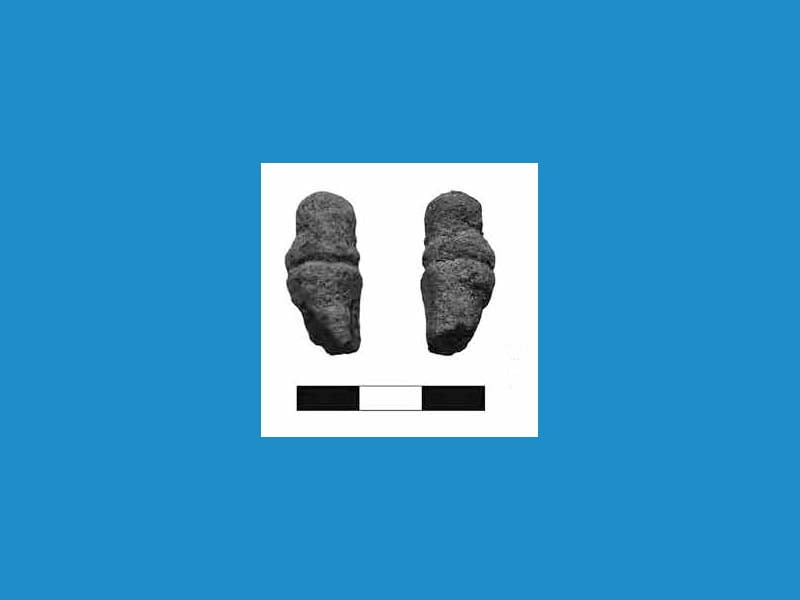
Idoletto of Grangiara (ph. MC Martinelli and others, 2014)
The few remains of structures found during the excavations in the locality of Grangiara, in the municipality of Spadafora in the province of Messina, such as fragments of plaster, strips of beaten concrete and small collapses, seem to indicate a residential context on the site, a hypothesis confirmed by the finding fragments attributable to tableware, consumption and conservation; moreover, objects such as weights and whorls, found both in the biconical and discoidal types, attest to the domestic activity of spinning.
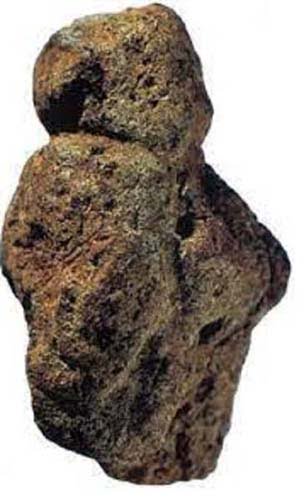
In addition to these objects, common in inhabited areas, a particular object of very small dimensions (2,5 cm.) was recovered during the excavation, made of purified clay of a yellow-ochre color with an approximately cylindrical shape, but modeled in such a way as to suggest to an anthropomorphic representation: the upper part is in fact rounded, in the central part it has two protrusions also rounded and separated by an engraved line, which would lead to identify a female figure (the engraved line would separate two anatomical partitions in which to recognize accentuated breast and belly) . Given the very small size, one could hypothesize its use as an amulet or ritual object to be held in the hands during prayer or ritual. Among other things, the similarity with the statuette of Berekhat Ram, found in the Golan Heights in Syria in 1981, now owned by the State of Israel and even dated to 230.000 years ago, is remarkable, in which on the piece of tuff (3,5 cm.) which naturally had a shape in which a female silhouette could be guessed, three incisions were made with a sharp stone, to accentuate the neck and arms, and consequently highlighting the parts referring to the breasts, belly and buttocks.
The tradition of female statuettes, which began as early as the Paleolithic - at the moment about 3000 female figurines have been discovered - continued throughout the Neolithic: there are over 100.000 examples in various materials (clay, marble, etc.), found in various sites (settlements, temples, tombs, etc.). As Judy Foster points out in “The invisible women of prehistory":"this broad range of Neolithic figurines, together with Paleolithic imagery, suggests a continued emphasis on the female form as well as their relationship to the powers of nature and the cycle of birth/life, death and renewal of all living things” (J. Foster, 2018).
The analysis of this type of finds was carried out in depth and with an organic approach for the first time by the Lithuanian archaeologist Marjia Gimbutas, who discovered many of these statuettes directly during her excavation campaigns, which, until that moment, they were called “Venus” from academic archeology. The interpretation, deriving from a male gaze, on the use and function of these objects identified a use aimed at fertility rites and/or erotic background, and therefore manifested partiality and limitation in the analysis of artifacts belonging to a culture that instead he was able to express a complex and profoundly spiritual symbolic thought. For the first researchers, the statuettes were therefore simply an expression of the "aesthetic" ideal of beauty of the time or simply realistic portraits of the "obesity" condition of women due to a diet based on cereals during the Neolithic.
Gimbutas' "feminine" gaze instead highlights the organic nature of the profound language of the sacred Feminine, and consequently a greater complexity at the basis of the link between feminine forms, and form, and the abundance of nature and the fertility of the earth, recalling the antiquity of this symbology - the attestation of these representations dates back to the Paleolithic - and noting that, since only the "basic forms" are represented and highlighted, the reference to female attributes and to what they represent is to be considered purely symbolic, analogical type, rather than a "portraiture" or realistic representation of a woman. The statuettes, of various sizes, shapes and materials, in fact identify a close bond, natural first, and symbolic by extension, between the forms of the Feminine (female in flesh and blood) and Nature, and between fertility and the life of the earth and the fertility manifesting in and through a woman's body.
A particular modality of this type of representation, highlighted by Gimbutas, is that in which the statuettes are more substantial in size and the shapes are very accentuated (especially, for example, in the artifacts with exaggerated buttocks of the Venus of Lespugue in France) and must therefore be considered a metaphor of the egg - and of the double egg - or of the pregnant womb, thus expressing an "intensified fertility". In the specific case of the artefact object of the present analysis, considering what has already been stated and highlighting its small size, it can be considered probable that it was an amulet or a small devotional object to be kept close at hand, or even in contact with the body ; as on the other hand, it has still remained a common practice in popular culture and tradition today (in Southern Italy, in the cultures of the Mediterranean and the Balkans) to bring objects with sacred or blessed value, amulets of various materials and symbols (apotropaic symbols, horns, hot peppers, sacred images) worn in the pocket, around the neck in contact with one's body or placed in cradles, under the pillow or between the swaddling clothes of newborns.
Historical notes
In the locality of Grangiara, a fraction of the municipality of Spadafora, a town on the Tyrrhenian coast of Messina, in August 2007, during excavation work for the Montalbano-Messina pipeline line, a site was identified which, under the most superficial archaeological layer (in which materials from the Roman and Hellenistic periods have been found), had a layer with a highly clayey matrix and characterized by the presence of fragments of ceramic mixture and lithic industry mainly on obsidian, attributable to the faces of Malpasso (late Copper Age – about 3400-2200 BC – final Sicilian Eneolithic); followed by a layer very similar to the previous one in composition and characterized by structures referable to the Middle Neolithic, faces of classic Stentinello; two very small lumps of metal (perhaps copper) and a fragment of pottery belonging to the Pianoconte facies were also found. Finally, still below, a layer consisting of a large area of fire almost completely devoid of archaeological remains. However, the few remains of structures found during the excavations can confirm the residential context; furthermore, other objects attest to the activity of spinning.

CARD
LATEST PUBLISHED TEXTS
VISIT THE FACTSHEETS BY OBJECT